




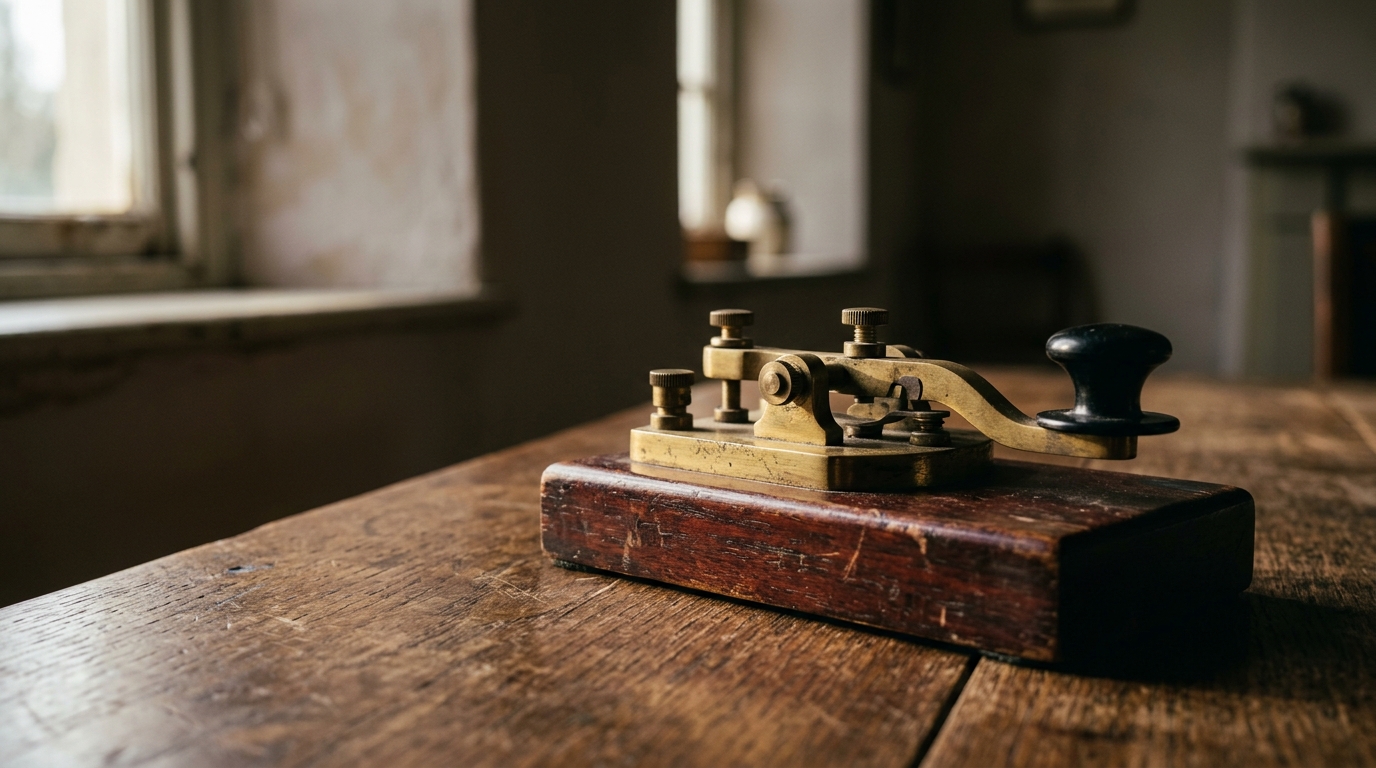
How electrical signals carried written messages across long distances before voice and digital networks.
What is a telegraph?
A telegraph is a system for sending symbolic messages over distance using signals rather than physically transporting the written message.
The electric telegraph used a key, a wire or network, and a receiver that marked or sounded incoming pulses. Morse code became one of its best-known symbol systems.
Why did it change society?
Before the telegraph, long-distance news traveled no faster than people, ships or animals.
Telegraphy made coordination across countries possible in minutes. It changed journalism, finance, railways, military planning, diplomacy and personal communication.
A short history
Electrical telegraph experiments preceded practical networks. Commercial lines expanded rapidly in the nineteenth century, often following railways.
Submarine cables connected continents. Telegraph offices converted messages into telegrams: written texts delivered through a communication network.
Telephony and radio later carried voice, while digital networks replaced manual telegraphy, but the basic idea of encoding information for a channel remained.
Limits and legacy
Telegraph messages were brief, paid by length and dependent on operators, infrastructure and shared codes.
The telegraph introduced a new social condition: events in distant places could affect decisions almost immediately.
Modern messaging, email and the internet are descendants of that same transformation from transport of objects to transmission of information.
Ai disclosure: written with the help of AI (ChatGPT). You are encouraged to point out errors and omissions.