



How short and long signals became a compact, human-readable code for communication.
What is Morse code?
Morse code represents letters, numbers and punctuation with sequences of short signals called dots and longer signals called dashes.
The symbols are separated by timing gaps. A message can be sent by sound, light, electrical pulses or radio.
Why was it useful?
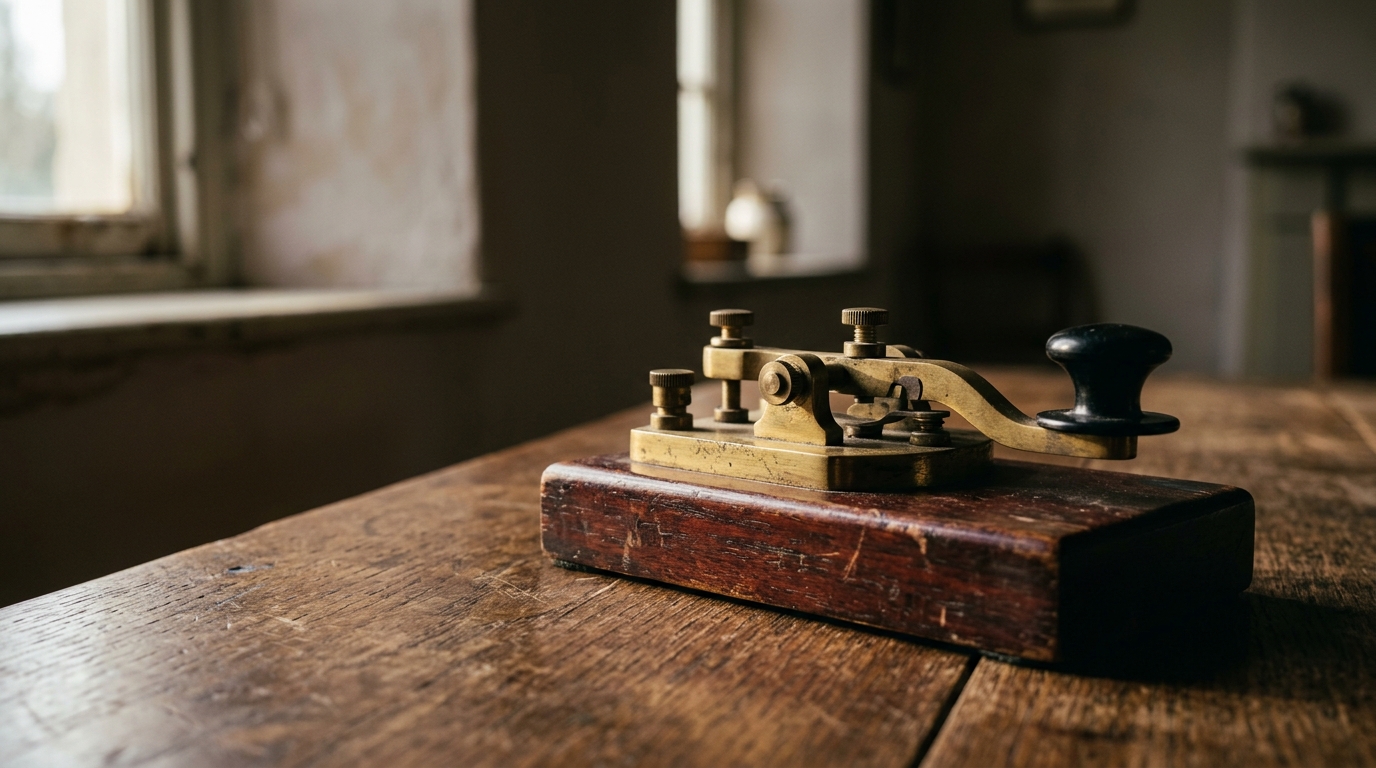
Morse code uses a small alphabet and can be transmitted with simple equipment. A skilled operator can distinguish a message even when a channel is noisy or narrow.
It allowed people to communicate through telegraph wires and later through radio without sending the full shape of written letters.
History
Samuel Morse and Alfred Vail developed a practical telegraph code in the 1840s. International Morse later adapted the alphabet for wider use.
The code supported railways, ships, news services, emergency calls and amateur radio. The distress signal SOS became widely recognized.
What does it teach?
Morse code separates meaning from medium. The same representation can be tapped, flashed, sounded or keyed.
It also shows that communication depends on timing, conventions, training and error handling—not only on hardware.
Future and legacy
Digital networks have replaced Morse for most routine traffic, but it remains useful in education, accessibility, historical practice and amateur radio.
Its deeper legacy is the idea that a simple, robust code can let people communicate through very limited channels.
Ai disclosure: written with the help of AI (ChatGPT). You are encouraged to point out errors and omissions.