


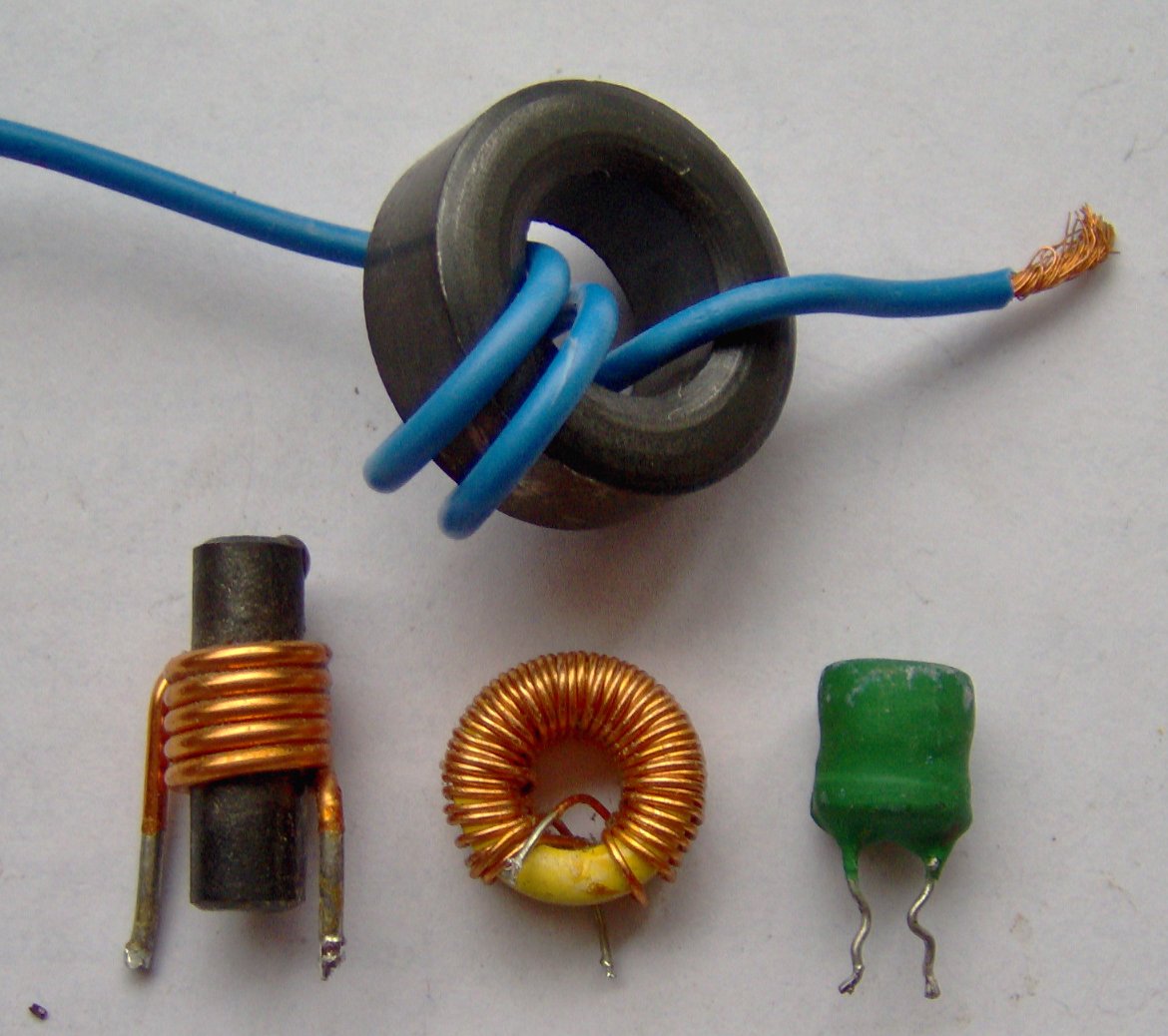
Miguel / Wikimedia Commons — CC BY-SA 3.0
How coils store energy in magnetic fields to resist current changes, filter signals and manage power.
What is an inductor?
An inductor is a passive two-terminal electrical component designed to store energy in a magnetic field when electric current flows through it.
The stored magnetic energy is given by E = ½ L I², where L is inductance in henrys and I is current in amperes.
How does it behave?
An inductor resists changes in current. Voltage across the inductor is proportional to how fast current changes: V = L (dI/dt).
It allows direct current (DC) to pass freely with only minimal resistance, but presents high impedance to alternating current (AC) as frequency increases: X_L = 2π f L.
Types and construction
Inductors come in diverse form factors tailored to specific applications:
- Air-core inductors: coils with no magnetic core, offering zero core loss and high stability for high-frequency radio circuits.
- Ferrite and iron-core inductors: coils wound around high-permeability cores to achieve large inductance in a small volume for power supplies.
- Toroidal inductors: donut-shaped cores that contain magnetic flux within the ring, minimizing electromagnetic radiation and noise.
- Surface-mount chip inductors: compact multi-layer or wire-wound packages soldered directly onto printed circuit boards.
Where are they used?
Inductors are essential across modern electronic systems:
- Power conversion: buck, boost, and flyback DC-DC converters rely on inductors to store and transfer energy smoothly between different voltage levels.
- Filtering and EMI suppression: choke inductors block high-frequency noise on power rails and communication cables while letting DC pass.
- Tuned circuits and resonance: paired with capacitors, inductors form resonant tanks for radio transmitters, receivers, and oscillators.
Non-ideal limits
Every practical inductor has limitations. The copper wire has DC resistance that produces heat. High currents cause magnetic cores to saturate, collapsing inductance. Parasitic capacitance between wire turns creates a self-resonant frequency above which the inductor behaves as a capacitor.
Ai disclosure: written with the help of AI (ChatGPT). You are encouraged to point out errors and omissions.