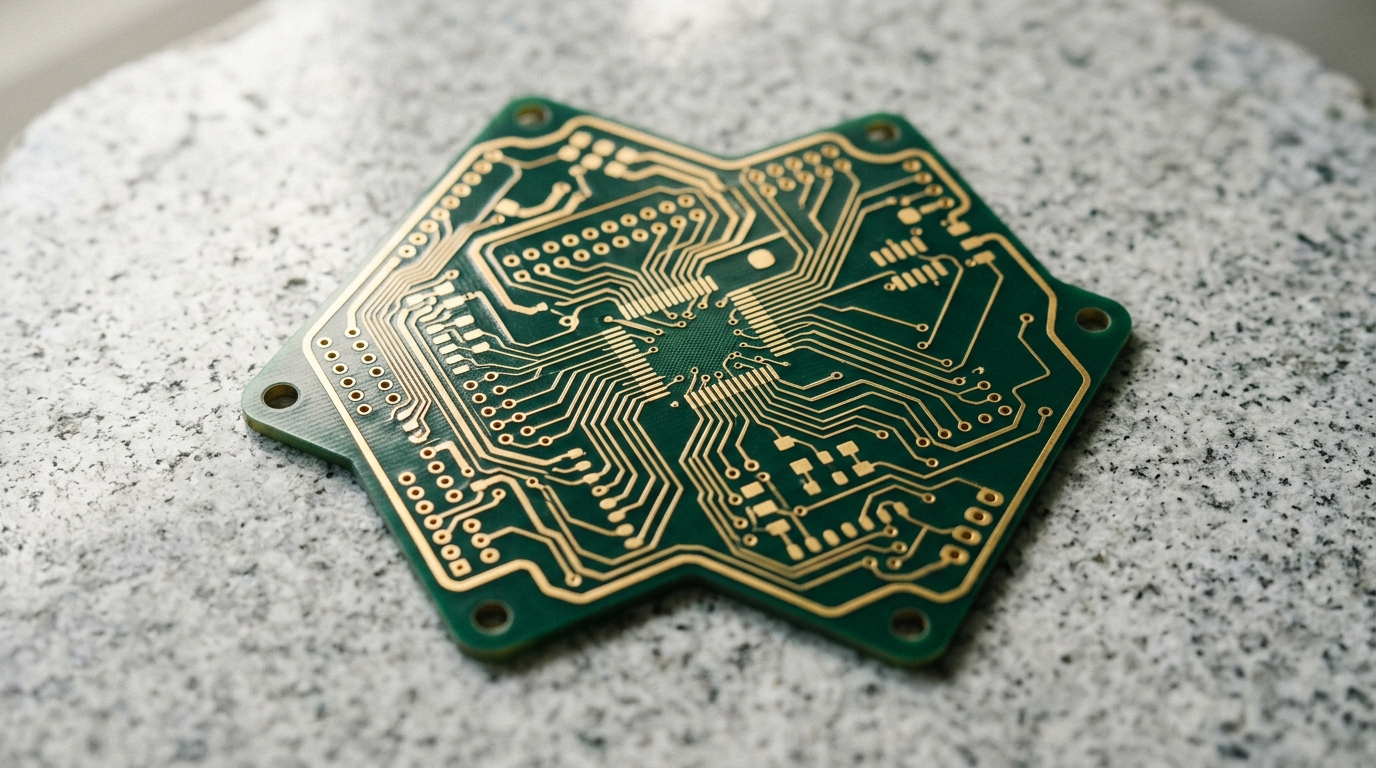




How discrete states, logic gates and stored bits make reliable programmable systems.
What is digital electronics?
Digital electronics represents information with discrete states, commonly interpreted as zero and one.
Real voltages are continuous, but a digital circuit defines ranges that count as valid states. This gives useful tolerance against small disturbances.
How does it work?
Transistors form logic gates such as NOT, AND and OR. Gates combine into adders, selectors, registers, memories and processors.
A clock can coordinate changes. A digital system may also be asynchronous, responding directly to events rather than a shared clock.
Digital design has two layers: hardware determines physical behavior, while architecture and software determine how the behavior is used.
Why is it powerful?
Discrete representation makes copying, storage, error checking and programmable transformation practical.
The same underlying circuits can handle text, images, music, measurements and instructions because all can be encoded as patterns of bits.
History
Relay logic and vacuum-tube computers preceded transistor logic. Integrated circuits, semiconductor memory and microprocessors made digital systems smaller and cheaper. Personal computers, mobile devices and cloud services extended the idea across society.
Limits and future
Digital systems still depend on analog interfaces, power, timing and physical media. They can fail through noise, bugs, security weaknesses or incorrect assumptions.
Future digital electronics will combine conventional logic with photonics, neuromorphic devices, quantum technologies and new forms of memory. Reliability, accessibility and human control matter as much as raw speed.
Ai disclosure: written with the help of AI (ChatGPT). You are encouraged to point out errors and omissions.