


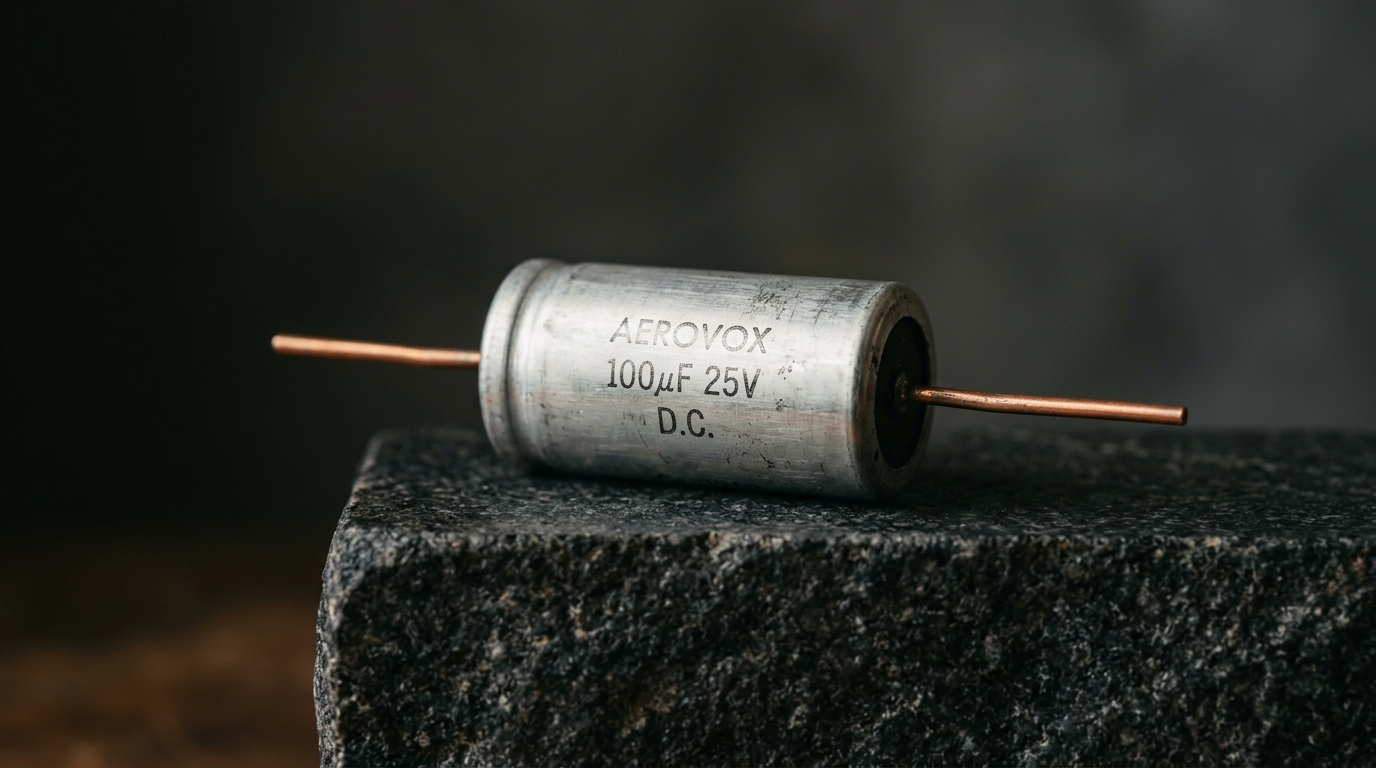
How separated charge stores electrical energy and shapes timing, filtering and power delivery.
What is a capacitor?
A capacitor stores energy in an electric field between conductors.
Its capacitance measures how much charge is stored for a given voltage: C = Q/V.
How does it behave?
A capacitor resists sudden changes in voltage. Current depends on how quickly voltage changes: I = C dV/dt.
It passes changing signals more readily than steady DC and can combine with resistors or inductors to set timing and frequency.
Uses
Capacitors smooth rectified power, decouple integrated circuits, filter signals, couple amplifier stages, tune resonant circuits and store short bursts of energy.
Real capacitors have leakage, equivalent series resistance, voltage limits, tolerance and sometimes polarity.
History and future
Early capacitors supported experiments in electrostatics and radio. Ceramic, film, electrolytic and supercapacitor technologies now serve different ranges of energy, voltage and lifetime.
Future storage will improve through new dielectrics and materials, but batteries remain better for many long-duration applications.
Ai disclosure: written with the help of AI (ChatGPT). You are encouraged to point out errors and omissions.