


Ujnotes — CC0 1.0
How modern language model applications structure pipelines, routing, retrieval, tools and state to produce reliable systems.
What is an LLM flow architecture?
An LLM flow architecture is the structural design of software systems built around large language models.
A raw language model is simply a statistical next-token predictor. Left on its own, it has no memory, cannot query internal business databases, cannot execute external tools, and cannot verify whether its own assertions are factually correct.
Flow architecture surrounds the model with deterministic workflows, query routers, context retrieval, tool integrations, and verification guardrails, turning an unpredictable model into a dependable production system.
Why single-prompt interactions fall short
In exploratory demos, people interact with an LLM by submitting a single question and reading the output. In production software, this monolithic approach quickly collapses:
- Context clutter and cost inflation: cramming complete instructions, historical conversation, and tool specifications into one giant prompt wastes tokens and multiplies response latency.
- Knowledge cutoffs and hallucination: models cannot inspect live databases, code repositories, or recent events without dedicated external retrieval pipelines.
- Compounding probabilistic error: if an operation requires five chained steps and each step has a 90% success rate, a single unguided prompt completes the task correctly only about 59% of the time.
- Lack of self-correction: once a model makes a flawed assumption early in its generation, it rationalizes that mistake and continues building upon it.
The core stages of a modern flow
High-reliability LLM applications organize execution into distinct, modular pipeline stages:
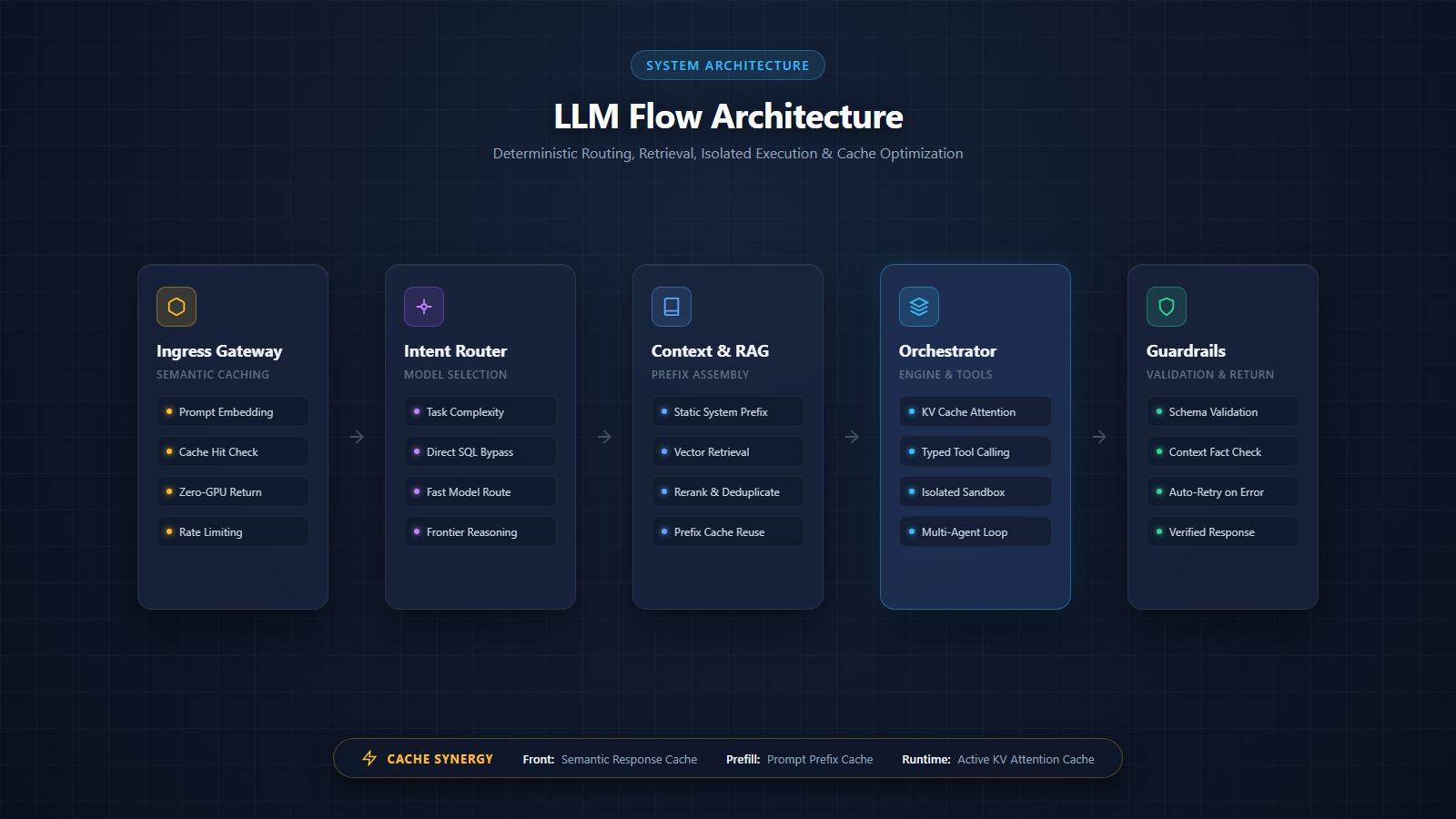
- Gateway and semantic caching: when a request enters the application, an ingress gateway evaluates incoming prompt embeddings against a semantic response cache. Identical or closely equivalent queries return pre-validated answers immediately, bypassing model invocation entirely and reducing latency to milliseconds.
- Intent routing and classification: a lightweight classifier assesses the query's complexity and intent. Simple factual queries route to compact, fast models; complex multi-step reasoning routes to frontier reasoning models; and structured data lookups route directly to SQL databases without calling any model.
- Context assembly and retrieval (RAG): relevant documents and domain knowledge are retrieved and reranked. The system deliberately arranges prompts with static rules and base instructions placed first to maximize prefix/prompt caching reuse across user sessions.
- Orchestration patterns: the flow coordinates execution using proven patterns—sequential chains for multi-step pipelines, parallel branches for consensus evaluation, or orchestrator-subagent loops for complex workflows.
- Tool execution in isolated environments: when the model needs to take actions, it produces typed parameters conforming to strict JSON schemas. Execution occurs in sandboxed runtimes, and real execution outputs feed back into the active context.
- State management and active KV caching: the system preserves conversational history and working scratchpads. Serving engines retain computed Key-Value attention tensors across turns, allowing multi-turn agent interactions to advance without recomputing earlier context.
- Verification and output guardrails: model responses undergo deterministic schema validation, source context fact-checking, and safety policy filters before reaching the user. If an output fails validation, an automated retry loop provides specific error feedback to guide self-correction.
How caching anchors the entire flow
Flow architecture and cache handling reinforce each other at every step:
- At the front entrance: semantic response caching intercepts high-volume queries before they ever consume GPU compute.
- During prompt prefill: designing deterministic prompt templates with static system instructions and documentation at the start ensures serving engines achieve high prompt prefix cache hit rates.
- During iterative execution: multi-turn agent loops append observations to the end of the context, keeping the shared history stable so the model engine reuses its KV cache rather than recomputing the full trajectory.
Engineering principles for dependable flows
Three core engineering principles distinguish robust LLM systems from brittle prototypes:
- Be deterministic wherever possible: rely on standard code for sorting, routing, schema validation, and calculations; use language models only where natural language understanding, reasoning, or synthesis is genuinely required.
- Small, focused prompts outperform sprawling contexts: decomposing a complex job into three chained subtasks with narrow, task-specific context consistently yields higher accuracy, lower cost, and faster response times than one enormous prompt.
- Instrument end-to-end observability: log complete execution traces for every routing decision, retrieved chunk, model prompt, tool call, and validation result. Without comprehensive tracing, diagnosing failure modes in non-deterministic systems is impossible.
Ai disclosure: written with the help of AI (ChatGPT). You are encouraged to point out errors and omissions.