



Papa November / Wikimedia Commons — CC BY-SA 3.0
How a quantum state changes in time and how probabilities arise from its mathematical description.
What is Schrödinger's equation?
Schrödinger's equation describes how a quantum state changes.
In its time-dependent form it is commonly written:
iℏ ∂ψ/∂t = Ĥψ
Here ψ is the state or wavefunction, ℏ is the reduced Planck constant and Ĥ is the Hamiltonian operator representing the system's energy.
What does it predict?
The wavefunction is not a classical material wave. Its mathematical structure is used to calculate probabilities for measurement outcomes.
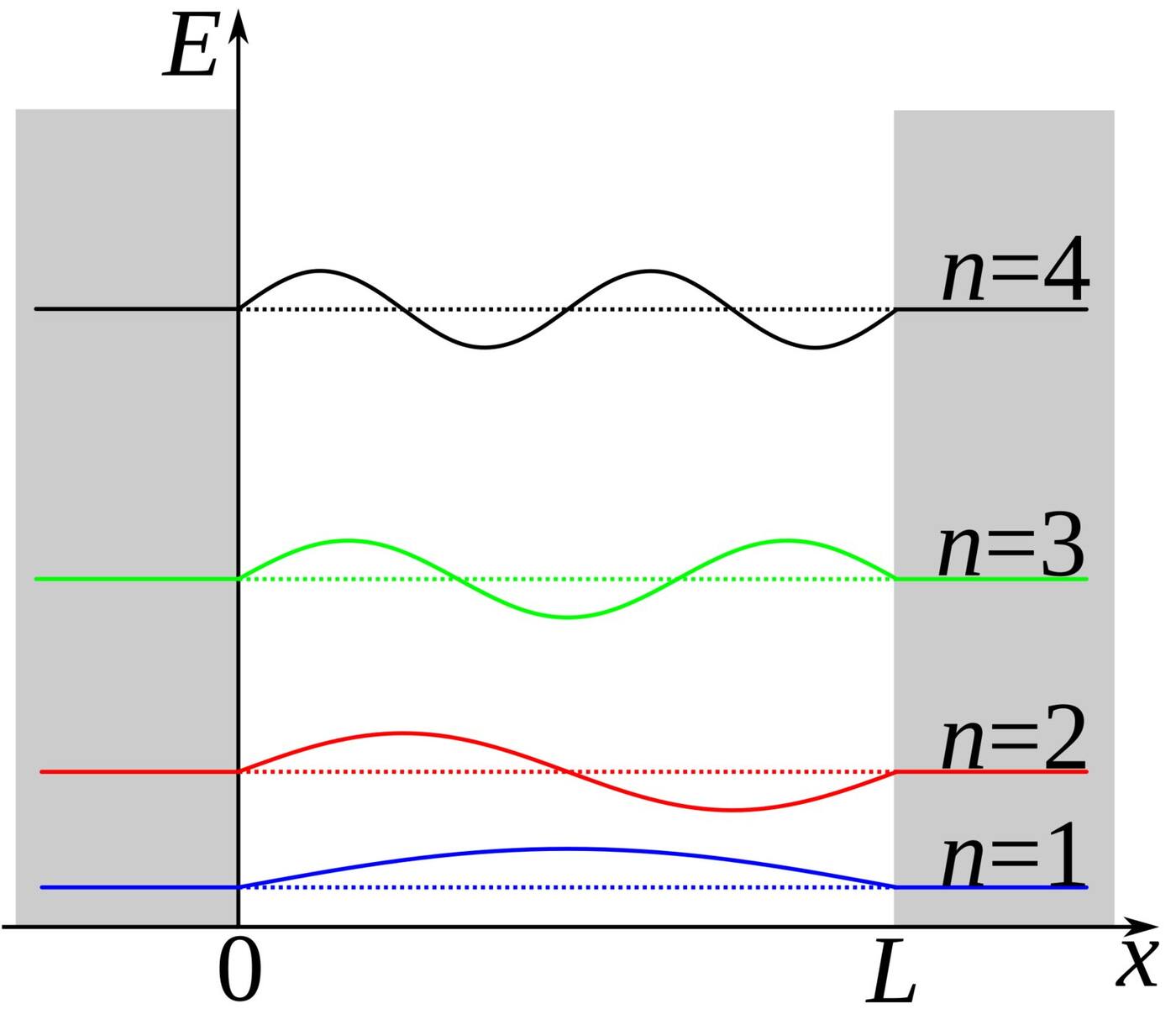
Solving the equation for a system can reveal allowed energies, spatial distributions, tunneling behavior and interference.
Why is it important?
The equation explains atomic orbitals, chemical structure, semiconductor behavior, lasers, quantum wells and many laboratory experiments.
It is one of the foundations on which modern materials and technologies rest.
Limits
The equation is non-relativistic and applies most directly to suitable systems. Relativistic quantum theory and quantum field theory are needed in other regimes.
A solution also depends on the Hamiltonian, boundary conditions and what is measured.
Future
Better control of quantum states may support sensing, simulation and computation, but engineering a useful device requires managing noise, measurement, fabrication and error correction.
Ai disclosure: written with the help of AI (ChatGPT). You are encouraged to point out errors and omissions.