


Tom Trower / Wikimedia Commons — Public domain
How stimulated emission creates coherent light and why lasers transform science, technology and medicine.
What is a laser?
A laser is a device that produces light through light amplification by stimulated emission of radiation.
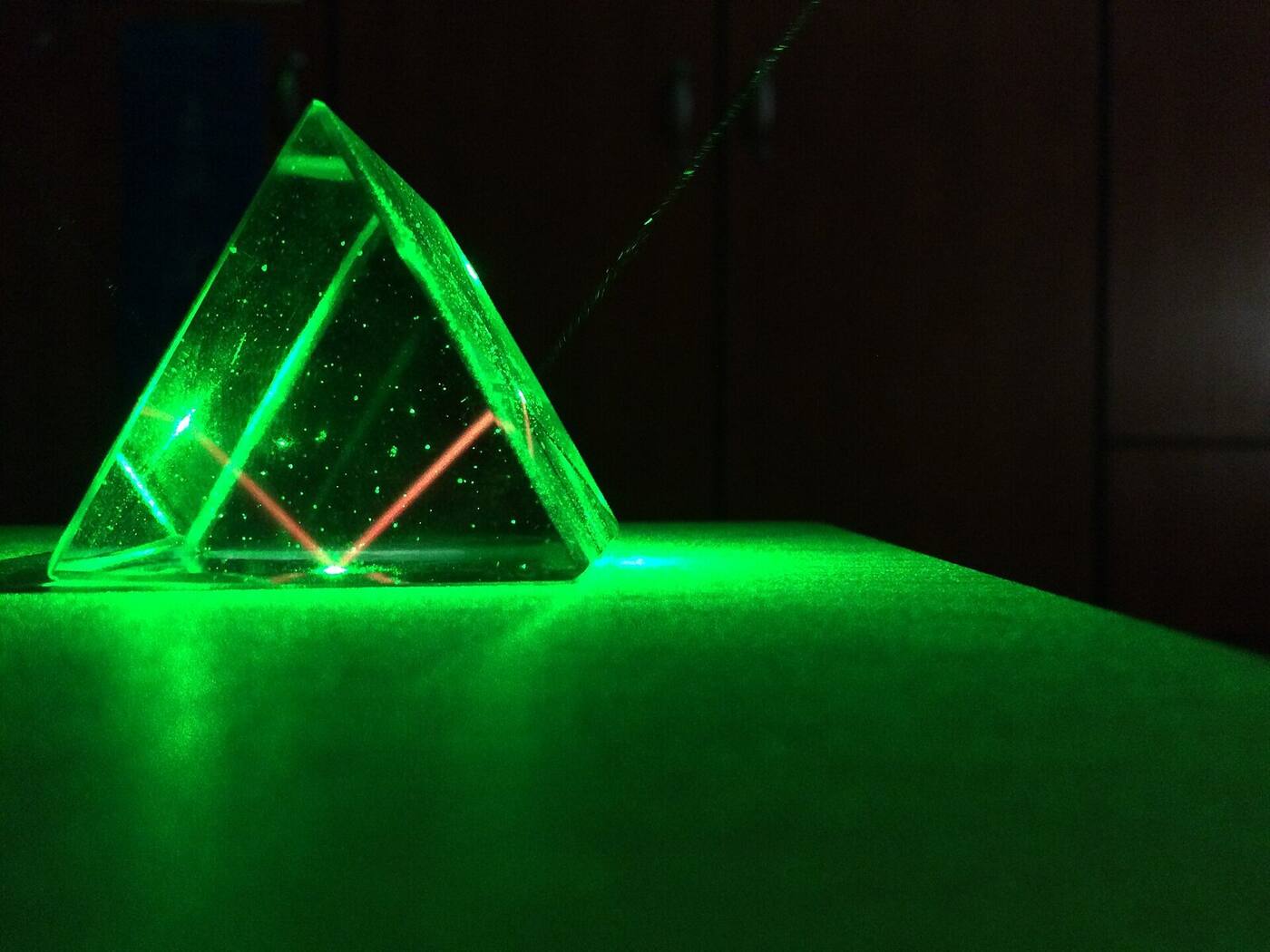
Its output is typically narrow in direction, concentrated in frequency, and strongly related in phase. These properties distinguish laser light from ordinary thermal or fluorescent light.
How does it work?
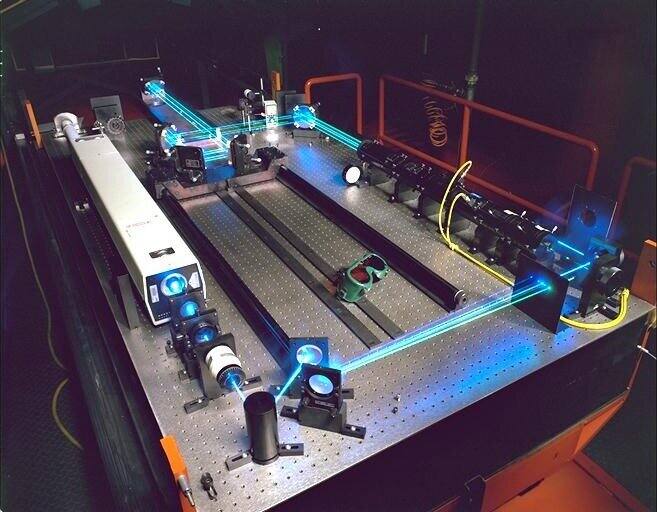
A laser has three essential parts:
- An active medium whose atoms, ions, molecules or semiconductor states can emit light
- A pumping mechanism that supplies energy and creates a population inversion
- An optical resonator that reflects light through the medium so stimulated emission grows
An excited system can emit a photon spontaneously. A matching photon can also stimulate another excited particle to emit a second photon with related frequency, direction and phase.
Why are lasers important?
Lasers enable optical fiber communication, barcode scanners, surgery, manufacturing, surveying, spectroscopy, microscopy, data storage, displays, printers, measurement and scientific experiments.
Their precision lets people cut, measure, communicate and manipulate matter with extraordinary control.
A short history
The maser demonstrated stimulated emission with microwaves. The first working optical laser was built in 1960. Since then, gas, solid-state, dye, fiber, semiconductor and ultrafast lasers have been developed for different wavelengths, powers and pulse durations.
Limits and risks
Lasers are not automatically efficient or safe. They can damage eyes and skin, heat materials, create hazardous reflections and require careful control of power and wavelength.
Real devices have noise, divergence, limited lifetime, thermal constraints and imperfect coherence.
Future impact
Lasers will support faster optical networks, precision manufacturing, medical treatment, autonomous sensing, astronomy, quantum technologies and experiments on extreme states of matter.
Their deeper importance is that quantum behavior can be turned into a reliable engineering tool: controlled light becomes a way to carry information, measure the world and change it.
Ai disclosure: written with the help of AI (ChatGPT). You are encouraged to point out errors and omissions.