


Guy vandegrift / Wikimedia Commons — CC BY-SA 4.0
How conservation of charge at nodes and conservation of energy around loops allow complete circuit analysis.
What are Kirchhoff's laws?
Kirchhoff's laws are two fundamental principles that govern how electric current and voltage behave across any electrical network.
Formulated by German physicist Gustav Kirchhoff in 1845, they generalize Ohm's law to handle complex multi-loop circuits with multiple power sources and branching junctions.
Kirchhoff's Current Law (The Junction Rule)
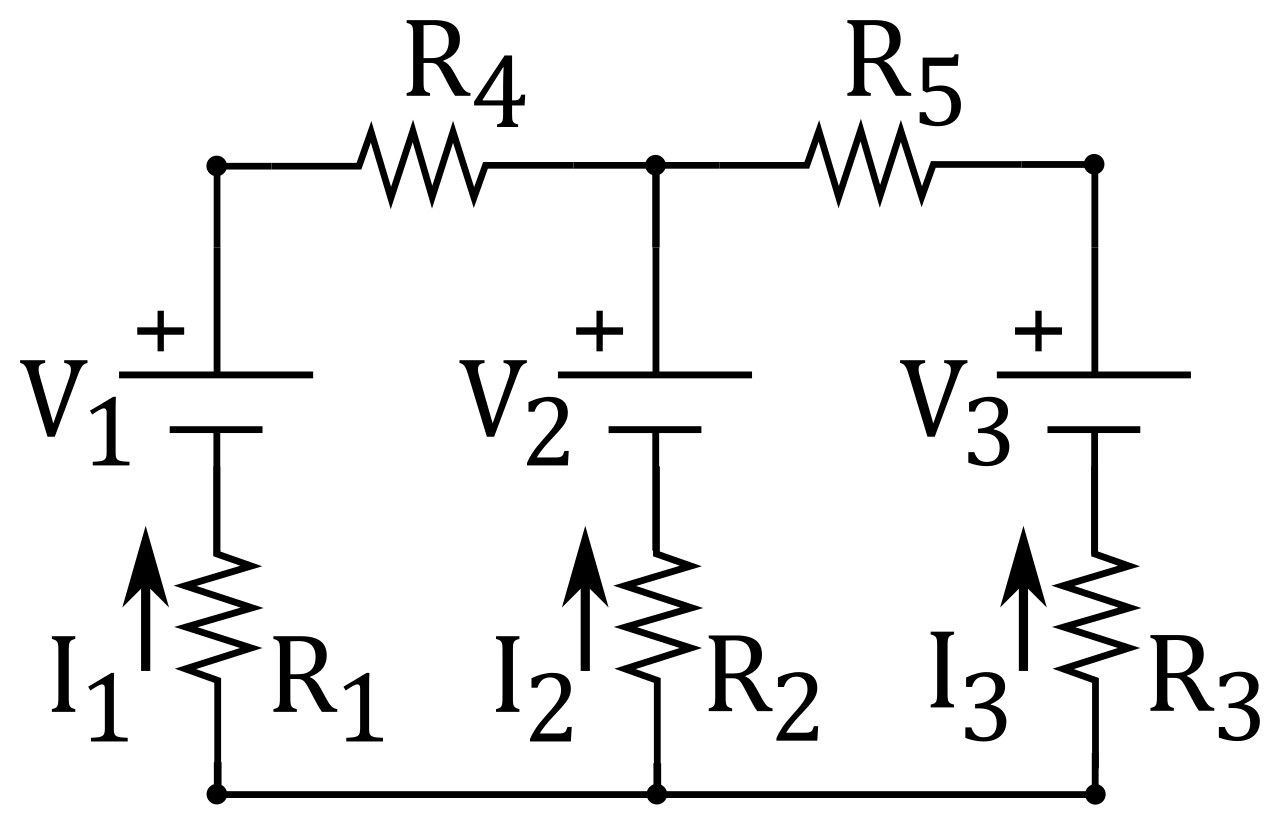
Kirchhoff's Current Law (KCL) states that the total current entering any electrical junction (or node) must equal the total current leaving that junction: ∑ I_in = ∑ I_out.
This rule is a direct physical expression of the conservation of electric charge. Electric charge cannot accumulate or vanish into thin air at a wire joint. Whatever charge arrives at a junction during any interval must depart through the connected branches.
If 5 amperes flow into a junction and 2 amperes exit through one branch, exactly 3 amperes must exit through the remaining branch.
Kirchhoff's Voltage Law (The Loop Rule)
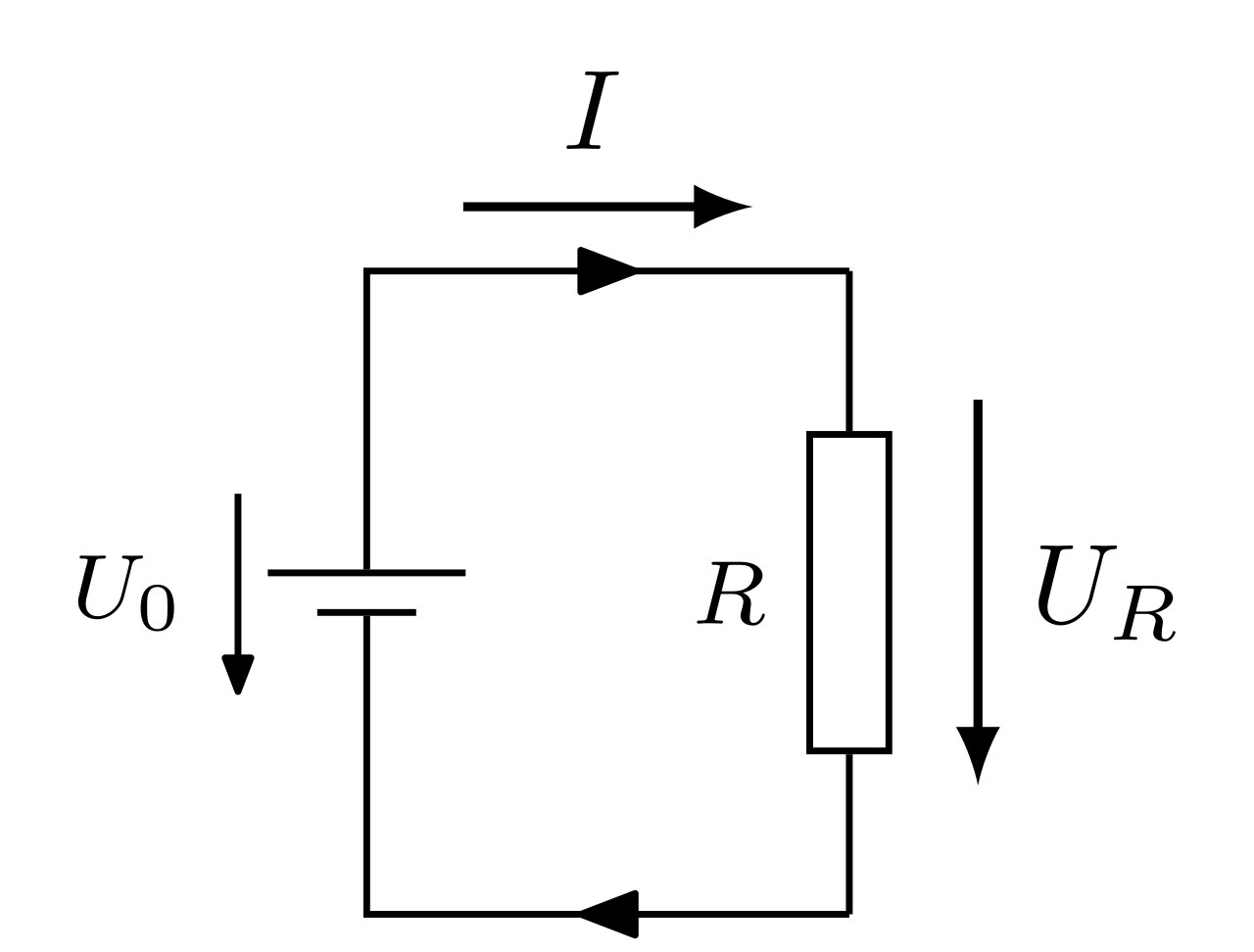
Kirchhoff's Voltage Law (KVL) states that the algebraic sum of all potential differences (voltages) around any closed loop in a circuit must equal zero: ∑ V = 0.
This rule reflects the conservation of energy. Electric potential measures potential energy per unit charge. If you begin at any point in a circuit, follow a complete closed path through batteries and components, and return to your starting position, your net change in electrical potential energy must be zero.
Gaining voltage across a battery is like climbing a hill; losing voltage across a resistor is like walking back down. By the time you complete the round trip, the gains and drops cancel out completely.
Why are they necessary beyond Ohm's law?
Ohm's law (V = I R) describes the relationship across a single resistive component. However, practical circuits—such as electrical distribution grids, Wheatstone bridges, and multi-transistor amplifiers—contain cross-linked loops and multiple interacting voltage sources where simple series or parallel reductions cannot work.
Kirchhoff's laws transform any complicated circuit into a solvable system of linear equations that directly yields every branch current and node potential.
How to apply them in practice
Applying Kirchhoff's laws systematically involves three basic steps:
- Identify nodes and loops: find all junctions where three or more conductors meet, and select enough independent closed loops to cover all circuit branches.
- Assign reference directions: label each branch current with an assumed arrow direction. If your algebraic solution produces a negative current, it simply means the true current flows opposite to your initial guess.
- Maintain consistent loop signs: traverse each chosen loop in one direction (clockwise or counter-clockwise). Treat potential rises across power sources as positive and potential drops across resistors (traversed in the direction of current) as negative.
Ai disclosure: written with the help of AI (ChatGPT). You are encouraged to point out errors and omissions.